
If you’re considering installing solar panels, you’ve probably heard the term net metering in Pakistan—but what does it mean?
Simply put, net metering in Pakistan is a billing mechanism that allows you to send extra electricity generated by your solar panels back to the grid. In exchange, your electricity bill gets reduced based on how much power you export versus how much you consume. It’s a win-win situation: your solar panels will not just power your home—they can lower your electricity bill up to 0.
How Do Solar Panels and Net Metering Work Together?

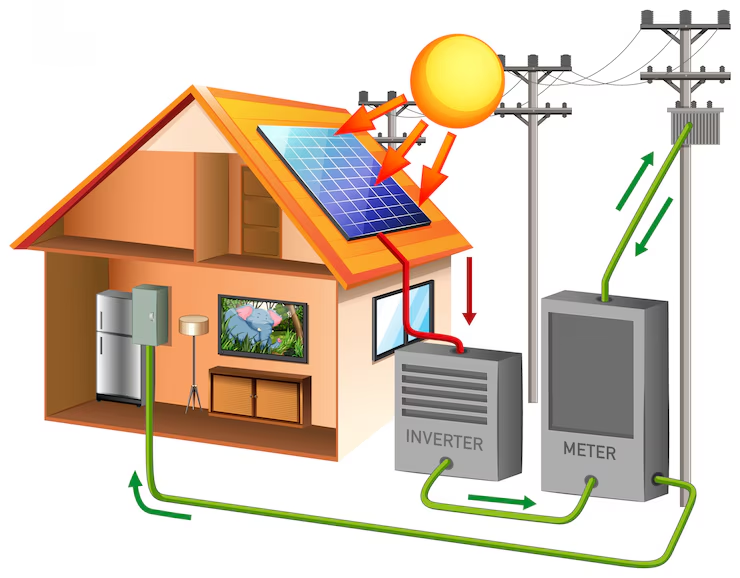
Here’s a simple breakdown of how net metering works:
- The solar panels generate electricity from the sun during the day.
- If your home uses less power than is generated by solar panels, the excess energy flows into the national grid.
- The electric meter records how much power you export and how much you consume.
- Through net metering in Pakistan, your power company adjusts your bill, subtracting the exported units from your total usage.
Think of it like a savings account for electricity—you deposit during the day and withdraw the power at night!
Real Example of Net Metering in Pakistan
For example, your solar panels produce 500 units of electricity in a month, but your home consumes only 400 units. With net metering, the extra 100 units are exported to the grid, and you’re credited for it. Next month, if you use 600 units, your bill will only be for 500 units.
Many households and businesses across Pakistan are already taking advantage of net metering, significantly reducing their WAPDA bills.
Who Can Benefit from Net Metering ?
Anyone with a solar panel system of 1 kW or more can apply for net metering. Whether you’re a homeowner tired of increasing bills or a business owner looking to cut operational costs, this system is designed to benefit you.
Even schools, hospitals, and industries are now shifting toward net metering to take control of their energy expenses.
How to Apply for Net Metering in Pakistan?
1. First, Check If You’re Eligible
Before starting the process of net metering, you must meet the basic requirements:
- -You have a 3-phase 400V connection (If you don’t have a 3-phase connection, you can apply for it before applying for net metering).
- -Your solar system is between 1 kW to 1 MW.
- -You have a valid connection from your local Distribution Company (DISCO).
- -You either own or have long-term control over the premises where your solar system is installed.
- -Your system must meet NEPRA’s technical standards.
If you tick all these boxes, you’re good to go!
2. Install a net-metering-compliant solar system (with a bidirectional meter).
3. Select a licensed vendor registered with AEDB (Alternative Energy Development Board).
4. Your vendor will handle the application process with your electricity provider.
5. After inspection and approval, you’ll get your net metering in Pakistan license
For the detailed procedure to know how to apply for net metering read : How to apply for net metering in Pakistan.
Common Questions
Q: Can I earn money from it?
You don’t earn direct money, but the savings are just like earnings. You pay less, or sometimes nothing!
Q: What if I don’t export power?
Then you’ll just use solar to offset your usage. But with net metering in Pakistan, any extra energy earns you credit.
Final Thoughts

Net metering in Pakistan is a powerful solution for reducing energy costs, achieving energy independence, and contributing to a sustainable environment. If you’re still relying entirely on grid electricity, you’re missing out on major savings, which can be wisely invested. With load shedding still a concern and electricity prices on the rise, now is the perfect time to explore solar power with net metering in Pakistan.
Why pay full electricity bills when the sun can cover the cost?
Reach us out:
Number: 0311 1306666
Email: info@trisunenergies.com
Website: trisunenergies.com